Bartering Sorter Matrix
Introduction
Purpose and Operating Limits
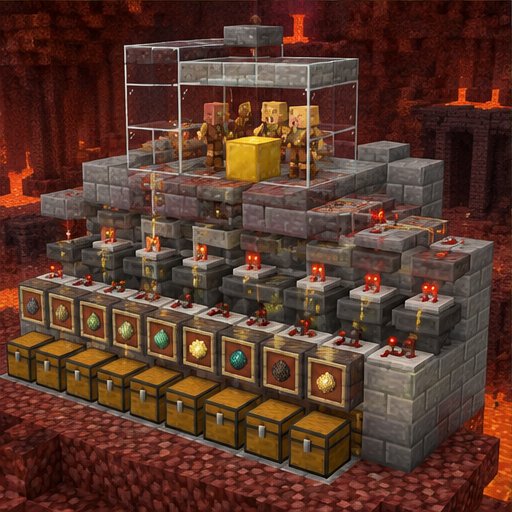
A bartering sorter matrix turns gold ingots into separate stores of gravel, Nether quartz, blackstone, and other piglin barter rewards. Its essential parts are a controlled gold feeder, a secure piglin cell, an item collector, and a bank of hopper filters. Build one working cell before adding more: reliable collection and overflow handling matter more than feeding speed.
Use adult piglins, not piglin brutes or zombified piglins. Bartering requires gold ingots; nuggets and raw gold do not work. Keep the installation in the Nether, where piglins remain piglins. In the Overworld or End, ordinary piglins eventually zombify. Barter loot and some automation behavior depend on edition, version, and server configuration, so verify your actual game rather than copying an old reward list.
Materials and Layout
For a single-cell starter, prepare one adult piglin, a name tag, an anvil for naming it, one dropper, a controllable slow clock, a lever, collection hoppers or a hopper minecart, rails if needed, building blocks, glass, and chests. Wear a gold armor piece while moving the piglin, but remember that opening containers or breaking certain gold-related blocks nearby can still provoke it.
A conventional stackable-item filter uses two hoppers, one comparator, one repeater, one redstone torch, three redstone dust, supporting blocks, and storage. Budget these per filter, plus the shared transport line. Confirm the exact footprint with a proven layout for your edition before gathering materials for a large bank.
Reserve space for a final overflow chest, an inspection walkway, and additional storage behind each output. Ordinary hopper filters cannot individually separate every barter reward: potions, enchanted books, and equipment need a catch-all destination or specialized sorting.
Build and Validate the Bartering Cell
Step 1: Build an enclosed Nether work area with a protected entrance. Use solid walls around the piglin and glass where you need visibility. Spawn-proof surrounding walking surfaces with suitable blocks, such as bottom slabs. Lighting alone is not dependable Nether spawn-proofing. Keep zombified piglins and soul-fire blocks away from the cell because they can frighten piglins and disrupt operation.
Step 2: Move one adult piglin into the cell using a controlled corridor, boat, or minecart arrangement appropriate to your edition. Name it to prevent ordinary despawning. Close every escape route before removing transport. Keep your maintenance position outside its reach, even when wearing gold armor.
Step 3: Install a dropper aimed at a pickup point inside the cell. Pulse it manually to dispense one ingot. A dropper ejects the ingot; it does not directly force a barter. Watch the piglin pick it up, inspect it, and throw rewards. Repeat several times to identify the actual landing area before positioning permanent collection.
Step 4: Collect rewards across that landing area. An exposed hopper floor is simple, but can steal ingots before the piglin picks them up. Separate the gold landing point from collection where possible, or lock affected hoppers during delivery. A hopper minecart beneath the cell floor is another option, but its pickup footprint must be tested and it must unload into a hopper. Neither approach automatically distinguishes gold from rewards.
Step 5: Add a slow clock with a clearly accessible stop lever. Piglins normally inspect gold for about six seconds in Java Edition and eight seconds in Bedrock Edition. Start with roughly ten seconds between single-ingot deliveries to one piglin. Confirm reliable pickup and collection before increasing throughput. Faster delivery can leave loose gold or overload collection rather than improve production.
Construct the Sorter Matrix
Step 6: Route collected items into a hopper transport line above the filters. Water streams are unsuitable for a normal Nether installation because placed water evaporates there. Point transport hoppers along the row, ending at an overflow chest. Keep nearby redstone from accidentally powering and locking these hoppers.
Step 7: Build one overflow-safe filter slice first. Its upper hopper holds the filter inventory and must not point into a container that would drain it. A comparator reads that hopper, while the conventional dust, repeater, and torch circuit controls the lower extraction hopper. Use the full circuit spacing: shortening the signal path or packing slices incorrectly can unlock neighboring filters.
Step 8: For a standard filter targeting an item that stacks to 64, load 41 target items into its first slot and one renamed filler item into each remaining slot. Use stack-to-64 fillers with a name never introduced into the transport line. This inventory produces comparator strength two; the next target item raises it to three, triggering extraction in the standard circuit. Do not apply the 41-item recipe to ender pearls, which stack to 16. In this same conventional circuit, pearls use ten target items and four fillers.
Step 9: Add filters for the rewards you actually receive, such as gravel, quartz, blackstone, obsidian, crying obsidian, and string. Label each chest. Java bartering commonly supplies spectral arrows; Bedrock supplies ordinary arrows instead. Keep both out of any automatic disposal plan until you have confirmed your loot table and storage needs.
Overflow, Troubleshooting, and Safe Expansion
Step 10: Keep all unmatched items in overflow storage initially. Test one matching stack, mixed rewards, and a full destination chest. An overflow-safe filter should retain its fillers and avoid disturbing adjacent slices when storage fills. Check that excess target items reach overflow rather than spilling onto the ground.
If gold appears downstream, correct delivery and collection timing. If rewards remain in the cell, expand collection coverage or clear blocked unloading. If filters lose fillers, inspect hopper orientation and redstone spacing. Stop gold delivery whenever overflow approaches capacity. Validate changes in a creative copy, then expand gradually. If server settings prevent reliable automatic pickup or timing, manually barter and feed the rewards into the same sorter.
Please support us by visiting one of our partners: Amazon