Goat Horn Collection Station
Introduction
What This Station Does
A goat horn collection station is a covered pen where you encourage adult goats to ram a suitable block, then collect the horns they drop. It is a manual collection setup, not an unlimited automatic farm: a goat has at most two horns, and lost horns do not regrow. Collecting every sound requires several goats, including screaming goats.
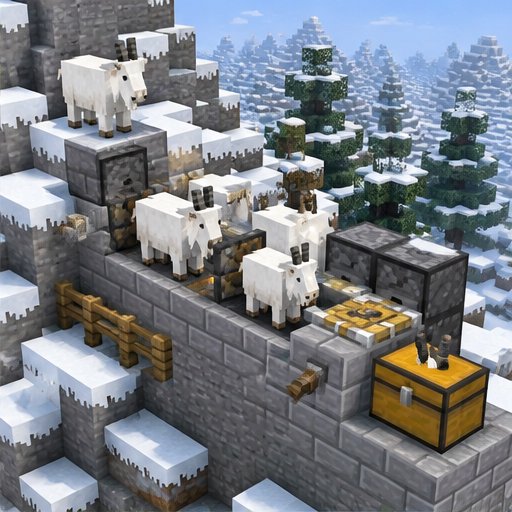
Goat horns are available in vanilla Java and Bedrock Edition from version 1.19 onward. The basic collection method works in both editions, but targeting, movement, and timing can differ. Server plugins or behavior packs may also change animal behavior. Validate one successful ram before expanding your station.
How Horn Collection Works
An adult goat can select a nearby stationary creature, including a survival-mode player, as a ram target. It prepares, lowers its head, and charges. If you move aside at the right moment and the goat strikes a qualifying block, it can drop a horn. Simply pushing a goat into a wall, attacking it, or standing behind an obstacle does not reliably trigger this process.
Use ordinary stone blocks as the impact surface. Stone is a valid horn-breaking block; cobblestone and stone bricks are not substitutes. Other qualifying blocks include packed ice, logs, and certain ores, but stone is inexpensive and straightforward to verify. Player-placed stone works; the impact block does not need to remain where it naturally generated.
Ordinary goats provide Ponder, Sing, Seek, and Feel. Screaming goats provide Admire, Call, Yearn, and Dream. You cannot choose a sound by changing the obstacle. Both horns from an individual goat have the same sound, so a second horn is a spare rather than another entry in the collection.
Materials and Location
Bring at least one adult goat with a horn, a lead, wheat, ordinary stone, building blocks for a complete enclosure and roof, gates or doors, lighting, and a chest or barrel. Signs help label the collection. Obtain ordinary stone with Silk Touch or by smelting cobblestone. Hay bales are optional landing cushions during transport, not a requirement or a valid horn-breaking target.
A practical starting enclosure has an interior roughly five blocks wide and twelve blocks long. Leave three clear blocks of height below a solid roof. This provides a straight approach and sideways escape space while containing the goat’s powerful jumps. These are working layout suggestions, not exact engine requirements.
Build and Operate the Station
Step 1: Choose level ground away from cliffs, lava, and powder snow. Build the walls and roof before bringing in the goat. Add lighting and a small two-gate entrance chamber so you can enter without opening a direct escape route. Keep storage outside the charging area.
Step 2: Make the center of one short end wall an ordinary-stone impact surface. A section three blocks wide and two blocks high gives you some tolerance for imperfect alignment. Keep the approach clear of fences, carpets, hay bales, and other obstacles that could alter movement or intercept the charge.
Step 3: Bring a goat from a mountain biome using wheat or a lead. Use a safe, gradual route rather than pulling it over drops. Shut the entrance, remove the lead, and keep only one goat in the working pen. Tethering or crowding the animal makes its movement harder to predict.
Step 4: Check that the goat is an adult and still has a visible horn. Baby goats cannot supply horns until grown. Keep spare goats in a separate holding pen; they can become alternative ram targets if left inside the station.
Step 5: Position yourself between the goat and the stone wall, about two blocks in front of the wall. Aim for a clear separation of several blocks between you and the goat; around six to eight blocks is a useful starting arrangement. Stand still and allow time for its behavior cycle. Ramming is not immediate or guaranteed on every attempt.
Step 6: Watch for the goat facing you and lowering its head. Once it commits to charging, move sideways out of its path. Do not retreat directly toward the wall. The intended sequence is goat, stationary player, then stone: your dodge exposes the impact surface behind you.
Step 7: After impact, look for a dropped horn and check whether the goat has lost one. Pick up the item promptly and read its sound name in the tooltip. Store it in a labeled chest section, separating new sounds from duplicates.
Step 8: Wait before attempting another ram. Goats have cooldowns, and screaming goats generally attempt rams more frequently. Once both horns are gone, move that goat to a breeding pen rather than continuing to bait it.
Completing the Collection and Fixing Problems
Breed adult goats with wheat to obtain more candidates. Screaming goats are rare and are best identified by their distinctive vocalizations, not appearance. Retain any you find for breeding, but do not assume every offspring will scream or provide a missing sound.
If no charge occurs, stop moving, increase the clear approach distance, remove other animals, and wait. If charges produce no horn, verify adulthood, remaining horns, and ordinary stone at the actual collision point. If the goat hits you, dodge laterally earlier and widen the escape space. Wear armor, keep health full, and avoid testing beside hazards.
If a server prevents reliable ramming, ask about its animal-behavior settings rather than enlarging the build blindly. Pillager outpost loot chests offer an alternative source for the four ordinary-goat sounds, though visiting an outpost is dangerous and does not replace screaming-goat collection. For layout testing, use a separate world copy; test player baiting in survival mode because creative-mode players are not equivalent ram targets.
Please support us by visiting one of our partners: Amazon