
Gold Farm Primer with Nether Portals
Introduction
Introduction
A Nether portal gold farm collects zombified piglins generated at Overworld portals, then delivers them to a controlled killing chamber. It can supply gold nuggets, occasional ingots, and XP, but Java and Bedrock use different portal-spawning mechanics. Start with one working collection module before committing to a large obsidian array. A functioning portal alone does not guarantee a useful production rate.
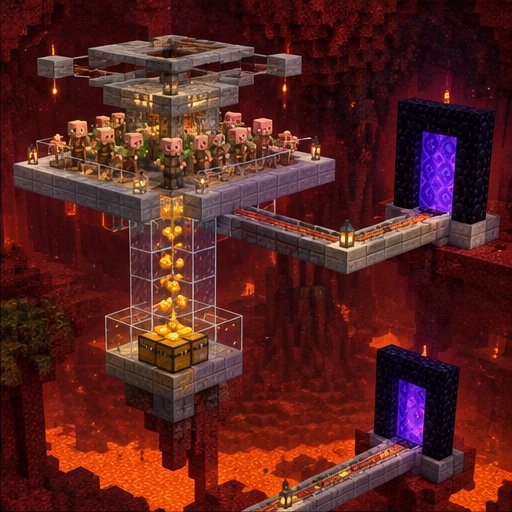
How Portal Gold Farms Actually Work
These farms generally do not transport naturally spawning Nether mobs into the Overworld. Instead, they exploit the normal ability of Overworld portal blocks to generate zombified piglins. In Java Edition, this generation depends on random ticks affecting portal blocks; larger active portal surfaces provide more opportunities. Difficulty also affects generation, and Peaceful is unsuitable.
Bedrock Edition designs commonly use repeated portal activation, with carefully timed extinguishing and relighting systems. Do not copy that circuitry into Java and expect equivalent results. Bedrock ignition methods, timing, and trident-killer behavior can depend on the current release and server implementation. Use a design documented for your exact edition and preferably your version.
Neither edition offers useful operation simply because a portal exists somewhere in the world. The relevant chunks must be loaded and receive the required simulation or random ticks. For the initial test, remain beside the farm rather than relying on remote chunk-loading arrangements.
Materials and Layout
For a small geometry test, a minimum portal needs 10 obsidian with omitted corners, or 14 with a complete rectangular frame. Its opening is two blocks wide and three blocks high. For expansion, the largest standard rectangular portal has an outer size of 23 by 23 blocks and a 21-by-21 opening. Its frame uses 88 obsidian with corners, or 84 without them. These dimensions apply to ordinary portals in both editions.
Bring flint and steel, at least two water buckets for establishing a renewable water source, nonflammable building blocks, glass for inspection, and signs or open fence gates for water separation. A basic collector can start with one hopper feeding one chest, though higher output needs more storage. Add a sword, preferably with Looting, and reserve redstone components for an edition-specific cycling or trident-killer module.
Choose a clear Overworld site with room below the portals for channels and storage. Distance from villages is not a portal-spawning requirement; separation is mainly useful for keeping hostile mobs and machinery away from normal activity. Avoid placing the farm where accidental portal linking would disrupt an important Nether route.
Step-by-Step Construction
Step 1: Confirm the operating conditions. Check your edition, release, non-Peaceful difficulty, and whether the server permits normal portal spawning and redstone operation. Ask the administrator about relevant plugins or entity limits rather than changing settings. Build the minimum portal first to check ignition, clearance, and collection geometry. Its low output makes it a poor short-duration test of production.
Step 2: Build dry catch platforms beside both broad faces of the portal. Enclose their outside edges with walls high enough to contain mobs, and leave adequate headroom. Keep water from flowing into the purple portal blocks: water contact can extinguish the portal. Route mobs toward collection trenches beside the dry landing area. Trapdoors may help some layouts, but do not assume piglins will reliably walk into a hole without a tested path or pushing arrangement.
Step 3: Construct water channels leading to a shared drop or holding cell. On a level floor, ordinary water flow extends up to seven blocks from its source; use descending channel sections for longer routes. Test every branch with loose items, then observe actual piglins because items do not reveal mob clearance problems. Remove dry ledges and corners where mobs can stop.
Step 4: Build an enclosed killing chamber with a protected attack opening. Position it so you can hit feet without exposing your body to adult or baby zombified piglins. Keep the initial drop short and finish mobs manually; excessive fall damage sacrifices XP and player-kill drops. Test with only a few mobs before allowing a backlog, especially because Java entity cramming can kill crowded mobs.
Step 5: Install collection beneath the chamber and verify that dropped items reach the hopper. In Java, hoppers do not collect items through a full solid block above them; an appropriate slab floor can permit pickup. Match the floor to the killing method. Keep an accessible path for XP orbs, which hoppers cannot collect.
Step 6: Expand only after mobs consistently reach the chamber. In Java, scale the active portal area while keeping catchments clear. In Bedrock, add a version-matched cycling module with a master switch. A dispenser containing flint and steel can ignite a correctly positioned portal, but extinguishing requires a separate mechanism. Verify repeated cycles without flooding the catch platform.
Operation, Troubleshooting, and Alternatives
If no mobs appear, check difficulty, active portal blocks, player proximity, simulation distance, and server restrictions. If output is intermittent, inspect channel congestion before adding portals. If a cycling portal stays dark, check ignition placement, timing, and flint-and-steel durability where applicable.
Manual sword kills provide a straightforward route to XP and Looting benefits. Bedrock trident killers can provide player-attributed kills in supported setups, but ownership and Looting conditions need version-specific verification; they are not a Java substitute. If portal mechanics are restricted, consider a supported Nether spawning-platform gold farm instead.
Separate nuggets, ingots, rotten flesh, and equipment before storage overflows. Craft nine nuggets into one ingot; nuggets are not smelted into ingots. Gold swords can be smelted into nuggets. Use ingots for piglin bartering, and collect XP while holding or wearing damaged Mending equipment to repair it.
Please support us by visiting one of our partners: Amazon